Missing Meta Conversions? Fix the Tracking Behind Your Ads.
When browser tracking misses important signals, campaign performance becomes harder to measure. I implemented Meta Pixel and server-side Conversions API tracking for a multi-location service business, then verified browser/server event processing and deduplication.

Imran Ahmed
Google Ads & Conversion Tracking Specialist
Direct technical guidance · No obligation · Real account diagnostics
Browser Meta Pixel captures user interactions while server-side CAPI transmits direct server payloads resistant to ad blockers and browser drops.
Synchronized event identifiers (event_id) ensure Meta registers each genuine lead and booking once without inflating conversion counts.
Independent datasets and pixel routing deployed for two business locations, keeping conversion signals clean and correctly attributed.
Why Conversion Tracking Was a Problem
Privacy restrictions and browser-side limitations, including those affecting some iOS users, can make it harder for advertisers to capture and measure all relevant conversion signals through browser-only tracking.
“Running Meta ads without reliable conversion tracking is like spending money in the dark. If important events are missing or measurement is inconsistent, it becomes harder to understand campaign performance and make informed decisions.”
Missing conversion signals
When relying solely on browser tracking, key actions like inquiry form fills, scheduled trials, and click-to-call taps can be missed due to ad blockers, network drops, or mobile browser restrictions.
Inconsistent performance evaluation
When conversion reporting fluctuates or undercounts, calculating accurate cost per lead and understanding which ads actually drive local enquiries becomes unreliable.
Difficult optimization decisions
Meta's automated delivery algorithms require steady, verified conversion data. Incomplete tracking starves the algorithm of quality signals needed to optimize budget allocation.
Context: The business operated two active locations with paid advertising driving client trials and inquiries.
Connecting Browser and Server-Side Events
I implemented Meta Pixel and server-side Conversions API tracking for both business locations, aiming to improve the reliability of conversion-event measurement without disrupting existing site workflows.
Browser-Side Event Tracking
Configured front-end event listeners via Meta Pixel and the existing platform integration to capture real-time visitor interactions across both location web pages.
Server-Side Conversions API
Set up direct server-to-server event delivery through Meta Conversions API (CAPI), ensuring conversion payloads bypass browser ad blockers and network drops.
Event Matching & Deduplication
Passed synchronized event_id and event_name parameters on both browser and server payloads, allowing Meta to identify identical events and deduplicate without double-counting.
Verification in Meta Events Manager
Ran real-time test events across both business locations to verify that events were received, processed, and deduplicated as documented in platform status logs.
Verified in Meta Events Manager
Test events confirmed that the relevant browser and server events were being received, with corresponding events correctly deduplicated in the reviewed examples.
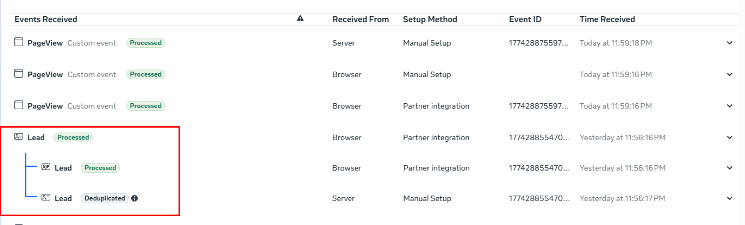
Meta Events Manager test events log showing the Lead conversion event received from both Browser (Partner integration) and Server (Manual Setup) with matching event ID. Meta processed the initial browser event and correctly deduplicated the server event to prevent double-counting.
Verification Note: Shared event ID: 177428855470... was synchronized across client-side and server-side payloads.
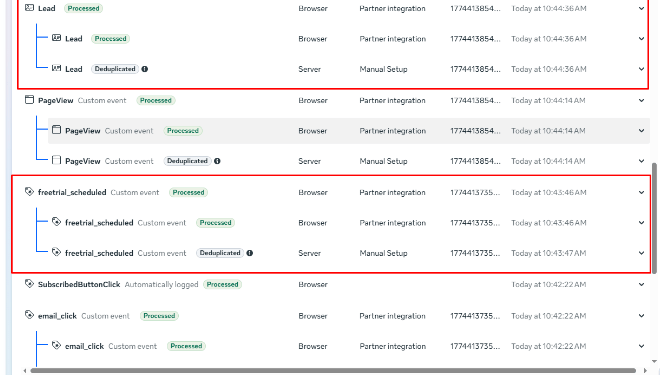
Location 2 test event stream verifying consecutive deduplication across primary conversion actions: Lead inquiry and freetrial_scheduled booking, alongside PageView activity. Both conversion signals were validated with matching browser and server timestamps.
Verification Note: Demonstrates multi-event pipeline stability with matching Event IDs across distinct conversion steps.

Detailed view of direct contact custom event (email_click). In this instance, the server payload arrived first and was Processed, while the subsequent browser payload was correctly Deduplicated with identical Event ID 177424157718...
Verification Note: Confirms that Meta deduplication works symmetrically whether the server or browser signal reaches Meta first.

Detailed view of click-to-call custom event (phone_click). Verified that high-intent contact actions are recorded reliably with synchronized event keys across browser and server endpoints.
Verification Note: Event ID: 177424157718... successfully matched between client-side tap and server-side webhook.
Client-identifying details (business names, location labels, pixel IDs, and dataset IDs) have been anonymized to protect account privacy while preserving the original platform evidence, event statuses, and deduplication records.
What Was Verified
The implementation outcomes are evidence-based facts directly supported by the reviewed Meta Events Manager test logs.
Two location setups configured
Meta Pixel and server-side Conversions API tracking were successfully deployed for both physical business locations, ensuring clean location-level data separation.
Core conversion events received
Reviewed test logs confirmed receipt of key conversion events: Lead inquiry submissions, freetrial_scheduled bookings, email_click, and phone_click interactions.
Browser & server deduplication working
The platform screenshots show verified Processed and Deduplicated statuses for corresponding event pairs, confirming that redundant signals do not cause duplicate conversions.
Verified measurement baseline established
By connecting browser and server-side pipelines, the business now provides Meta with resilient, verified event signals to support ongoing campaign optimization.
Technical distinction: Event delivery and deduplication verify tracking functionality. Correct data delivery improves measurement dependability, but does not independently prove or guarantee increases in leads, revenue, or ROAS.
Why Reliable Tracking Matters
Three practical reasons why robust Meta tracking matters to business owners and marketing decision-makers.
Better measurement signals
Give Meta a more complete set of eligible event signals where browser and server tracking can support them, reducing signal loss from network drops and browser interruptions.
Clearer reporting
Reduce avoidable measurement inconsistencies caused by duplicated or missing event delivery, ensuring you see an accurate record of customer interactions.
More informed decisions
Help advertisers evaluate campaign performance and make budget adjustments using dependable conversion data rather than guesswork.
Note: Server-side tracking strengthens measurement resilience but does not bypass legal consent rules, overcome platform opt-outs, or guarantee advertising results.
Are Your Meta Ads Missing Conversions?
I help businesses diagnose Meta Pixel and Conversions API issues, validate event delivery, and build more reliable conversion measurement.
30-minute introductory call · No obligation · Direct consultation with Imran Ahmed